Daily routines
Tiny Bites
Bite shaping for food selectivity, with a choice board
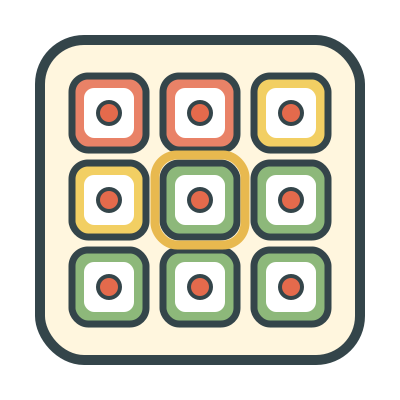
A choice board of 21 steps with a new food, from Look covered to Swallow 4. The learner picks a step and does it. Each card’s color says how much reward to give: green for all rewards, yellow for some, red for none. You set each step’s color for the learner.
When
- Treating food selectivity with a shaping hierarchy, where the learner chooses how far to go with each bite.
- Learners who do better with a visible choice and a clear, steady rule for what each choice earns.
Why
- The learner always has a choice, and the color shows the reward before they choose, so a bigger step always pays more.
- The board follows the learner’s criterion. When the criterion moves up, the colors move with it, one step at a time.
- The reward time counts down on screen and a soft tone ends it, so each reward is the same length.
- Every pick is saved with its color and your score, so you can see which steps the learner picks and when to move the criterion up.
How
- On the setup screen, pick Full reward starts at. That step and the steps after it get full reward (green), the 2 steps before it get some reward (yellow), and the rest get none (red). Then tap a color on any step to change it, or hide a step.
- Under What each color means, you can pick other colors, and set the reward times (to start, 45 seconds for full and 30 for some). Pick a Food picture for the cards, then tap Play.
- Present the food. The learner taps a card. Score it: Did it, Problem behavior, or Didn’t do it. Wrong card puts the pick back and saves nothing.
- The screen turns the card’s color and counts down the reward. A red step, or a step not done, says to take the food away. Tap Next trial.
- Use Back to take out the last trial. End goes back to setup.
Saved to the dashboard: Every step the learner picks, its reward level at the time, and your score. A trial meets the goal when the learner does a full-reward step without problem behavior. Each session shows the percent that met the goal, the highest step done, and each step’s scores. Moving where full reward starts begins a new phase on the graph. The food picture isn’t saved.