Listening
Put It
Following instructions with in, on, under, next to, and in front of
A recorded instruction such as “Put the frog on the lily pad” or “Put the hat on the shark.” Three things wait at the front of the scene (a frog, a butterfly, and a bee), and two or three places stand behind them. The learner picks the named thing and drags it to the named spot. There are 11 scenes: a playroom, a road, a pond, bedtime, snack time, a bathroom, the ocean, a forest, space, laundry, and trains.
When
- Teaching or probing prepositions as a listener skill, once the learner knows the names of the things and places.
- Checking that a word such as on carries over to new places (a table, a bed, a shark) and new things.
- Building toward two-part instructions, where both the thing and the word matter. Start with 1 thing if the learner isn’t ready to pick the thing too.
Why
- Most places take at least two words (on and under the table), so knowing the place’s name isn’t enough. The word decides the answer.
- With 3 things, any of them can be named and all of them can be moved, so the learner has to pick the right one. Moving another thing to a spot is a wrong answer. With 1 thing, only the named thing waits, so the learner only decides where it goes. The places don’t move: pressing one just makes it wobble, and that isn’t scored.
- Each instruction is recorded, so it sounds the same every time, with no glance or gesture toward the answer. The places change order at random, so position doesn’t give the answer away.
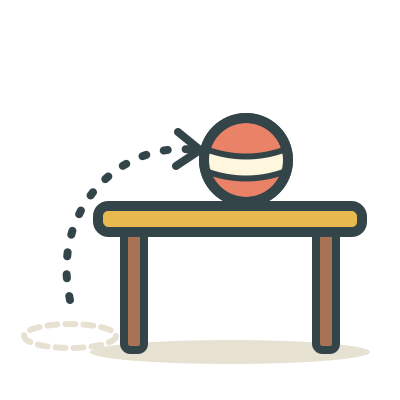
- Every spot counts at every level: putting the ball under the table when asked for on is scored as under the table. Letting go in empty space puts the thing back and isn’t scored. Next to the lily pad is in the water too, so it counts when asked for in the water.
- A wrong placement stays put for a moment, then the thing goes back and a faint copy of the named thing, in a teal ring, shows where it belongs. That is a prompt, and it isn’t scored as correct.
How
- On the setup screen, choose a level and how many things wait at the front, then tap Play:
- In or on — Put a thing in or on a place, such as the ball in the box or the frog on the lily pad. Every place stays a choice, so putting it under or next to a place counts as a wrong answer.
- On or under — Put a thing on or under a place, such as the car under the bridge or the book on the bed. Uses the scenes that have both.
- In, on, or under — Put a thing in, on, or under a place. The 3 words take turns, mixed across the scenes.
- In, on, under, or next to — Adds next to, which works with almost every place. The 4 words take turns, mixed across the scenes.
- All, with in front of — All 5 words, adding in front of (the flower at the pond). The words take turns, mixed across the scenes.
- The first instruction plays right away. Tap the speaker button to repeat it. The instruction is also written below it for you.
- Let the learner pick a thing and drag it. A correct placement earns a star and moves on to a new scene. A wrong one prompts the right thing and spot.
- Use Skip, Log, Hold to reset, and End the same way as in Find It. Rounds are 10 instructions.
Saved to the dashboard: The first thing put in a spot on every trial, and where, plus skips. Each thing and spot is a target (Frog on the lily pad, Truck under the bridge), and the most common errors show what went where instead: Frog on the lily pad → Frog next to the lily pad is a wrong word, and → Bee on the lily pad is a wrong thing. Changing the level, or between 1 and 3 things, starts a new phase on the graph.